 |

Drinking Water Treatment Methods
Be an
Informed Consumer |
|
|
Drinking Water Treatment Methods
Be an
Informed Consumer |
 |
Overall, the United States and most developed countries have very safe public water supplies. Regulations and enforcement policies require treated water to meet quality standards designed to significantly reduce levels of contaminants that can cause health problems, both immediate and long term. Depending on the source water quality, different strategies are used to remove as many harmful contaminants as feasible and provide water that can be distributed to the public without significant re-contamination. This is a fairly simple example of the basic process. Consequently, there is very little risk of any individual experiencing harmful health effects from drinking tap water in countries with effective regulations and reliable water treatment programs. Reliably safe water and little risk, however, does not mean zero risk. Contaminants remaining after water treatment or picked up from the distribution pipes or from home plumbing can increase health risks slightly. Rare, localized accidents and treatment failures can also temporarily increase contaminant levels. Required levels of residual disinfectants can cause taste and odor problems in some cities. A drinking water treatment system certified to reduce those contaminants that remain in your tap water can provide an extra level of protection and almost completely eliminate any health risks. Everyone has different levels of risk tolerance. Mine is fairly high, but as discussed elsewhere, there were three concerns that prompted my wife and me to research water treatment systems in 1996 - possible lead contamination from our old plumbing (The word plumbing is derived from the Latin plumbum for lead), a desire to remove disinfection byproducts and an interest in providing protection against accidents. |
||||||
|
|
If you decide purchase a water treatment
system, first you need to understand which contaminants are in your
water. If you are on municipal (public) water, most water
companies are required to provide an annual water quality report
that will list contaminant levels and provide other useful information
about your drinking water.
EPA,
NSF,
EWG As described on my website every treatment choice - whether
it is for a city or a home - has outcomes that consist of benefits,
costs, and risks. In addition to understanding your water quality, consider these six suggestions (no Java) before purchasing a water treatment system. As described on my website every treatment choice - whether it is for a city or a home - has outcomes that consist of benefits, costs, and risks. The goal is to make those choices so benefits are maximized for the most people, risks are minimized and costs are manageable. |
||||||
|
|
There are three main point of use water
treatment methods - Each process has benefits, costs and limitations
that must be balanced. No treatment method is 100% effective
at removing contaminants, although distillation is close.
|
||||||
|
|
There are no federal regulations regarding the effectiveness or design of water treatment products. The FTC has created "truth in advertising" rules, but they apparently are not enforced except in extreme circumstances. Consequently, the Internet is a minefield of unsubstantiated claims, and it is your responsibility to ensure that all marketing claims are valid for any water treatment product purchased. | ||||||
|
|
Careful selection of water treatment products certified by NSF or WQA provides assurance that water treatment claims are valid. You will find many vendors of water treatment products that provide no 'proof' of effectiveness besides claims made in their marketing materials - no independent validation of claims. You will also find products with claims that they have been tested to NSF standards - that's very different from NSF certified and essentially meaningless. | ||||||
|
|
You may encounter a subtle form of marketing scam where a door-to-door sales person shows up to 'test' the safety of your tap water - or you may sign up for a 'free home water test'. The sales representative may or may not be selling a legitimate product, but they will almost certainly employ a variety of chemical tricks and slick explanations to demonstrate how easily absorbed and dangerous chlorine is, how dissolved minerals can be precipitated to form an unhealthy-looking sludge, and present other demonstrations designed to showcase the alleged dangers of your tap water. These revelations may appear convincing, but they are almost certainly smoke and mirror illusions carefully designed to trick you into spending several thousand dollars on a water treatment system you don't need. | ||||||
|
|
Many water treatment products are marketed with claims that the physical or chemical properties of water have been altered to create a molecule or cluster of molecules with special healing properties. These products may appear to work because of the Placebo Effect, and there may be numerous passionate and compelling Testimonials of effectiveness. However, I have searched carefully over the years, and I have never seen any evidence that the alleged processes have any effect on water molecules or that the resulting product is anything more than an ovten very expensive placebo. |
Introduction Things to Consider | Truth in Advertising | NSF Certification | Point of Use vs. Point of Entry
 Things
to Consider when Selecting a Water Treatment Method:
Things
to Consider when Selecting a Water Treatment Method:The United States and most developed countries have regulations and provide oversight to ensure municipal water is safe to drink and use without harmful health effects for the overwhelming majority of citizens. Government Regulations require that the most potentially harmful contaminants be monitored and the levels of the regulated contaminants in the treated water not exceed established limits. Depending on specific water characteristics, treatment processes might include adding compounds to adjust pH, control corrosion, coagulate suspended materials, etc.
Community water treatment has saved countless lives by significantly reducing levels of many harmful compounds, and providing disinfection that has all but eliminated once common epidemics like cholera and typhoid fever. For example, contaminated drinking water is a significant way typhoid fever can be transmitted, and according to the CDC, before water disinfection was started in 1908 there were about 76,000 cases of typhoid fever in 1900 in the U.S. (about 0.1% of the population affected) compared with about 88 cases in 2006 (less than 0.0001% of the population).
In the United States two levels have been created for each regulated contaminant: The Maximum Contaminant Level Goal (MCLG), "The level of a contaminant in drinking water below which there is no known or expected risk to health. MCLGs allow for a margin of safety and are non-enforceable public health goals." and the Maximum Contaminant Level (MCL), "The highest level of a contaminant that is allowed in drinking water. MCLs are set as close to MCLGs as feasible using the best available treatment technology and taking cost into consideration. MCLs are enforceable standards."
"Drinking water, including bottled water, may reasonably be expected to contain at least small amounts of some contaminants. The presence of contaminants does not necessarily indicate that water poses a health risk. EPA sets standards for approximately 90 contaminants and indicators in drinking water." (EPA page)
An example from the CDC discusses the risk of one of the disinfection byproducts caused by chlorination, "The result detailed that over 70 years, an upper bound estimate of the probability of cancer due to chloroform is 0.24 cancers per 1,000,000 people per year. The rate of cancer in the US is approximately 1,930 / 1,000,000 per year. Thus, the extra cancer from chloroform was calculated to be negligible." So, in the process of saving many thousands of lives a year, the chloroform caused by chlorination might be expected to cause 77 of the 619,000 annual cancer cases. Not a bad trade-off - unless you are one of the 77. To put that risk in perspective, in 2016 an average of 90 people were killed in car crashes every day, according to the CDC increasing to 117 deaths/day in 2021 according to Reuters.
There is very little risk of any individual experiencing harmful health effects from drinking tap water in countries with effective regulations and reliable water treatment programs. Reliably safe water and little risk, however, does not mean zero risk, as illustrated with the disinfection byproduct example. Contaminants remaining after water treatment or picked up from the distribution pipes or home plumbing can add to the health risks. Rare, localized accidents and treatment failures can also temporarily increase contaminant levels. Required levels of residual disinfectants can cause taste and odor problems in some cities.
A drinking water treatment system certified to reduce those contaminants that remain in your tap water can provide an extra level of protection and almost completely eliminate any health risks. As discussed elsewhere there were three concerns that prompted my wife and me to research water treatment systems in 1996 - possible lead contamination from our old plumbing (The word plumbing is derived from the Latin plumbum for lead), a desire to remove disinfection byproducts and an interest in providing protection against accidents.
The first thing to consider, even before you start examining different types of water treatment systems, is the actual quality of the water supplied to your home - either from a municipal drinking water provider or from a private water source. If you are starting from scratch it will take some dedicated research to understand the risks that various contaminants pose at levels typically found in drinking water - and specifically in your drinking water.
Private water supplies (individual and small, shared community wells, etc.) are not regulated and can potentially contain any contaminant at any level. Consequently, the decision to treat private water supplies and the necessary treatment solutions are often more complex than the decision of whether and how to treat municipal water. The treatment methods discussed on this site are still relevant, but additional processes might need to be considered.
If you decide to treat
your drinking water, you will need to determine which of the solutions is
best for your needs. To make an informed decision, you might want
to carefully consider the following six suggestions:
| 1. | How much purified water you would like to use per day for drinking and cooking (a family of four will probably use 3 to 6 gallons per day). If you are transitioning from no filtration system (where all tap water in your home is the same) or from using bottled water (where a limited supply must be rationed) to a filtration system where water is treated as it is used, the amount needed may be difficult to judge. It is important to have an idea though, since that will help you calculate your ongoing costs of treatment. |
| 2. | Determine which contaminants are actually in your water (and which ones might occasionally show up). The only way to know this for sure is to request a report from your municipal water supplier or have your water tested. |
| 3. | Determine which contaminants you are interested in removing (the information on the other pages of this site should help). The plan I adopted was to go with a solution that would provide the best protection from most of the potential contaminants, for the lowest ongoing cost and and requiring the least maintenance - even though most of the contaminants the filter will remove are not currently present in my tap water. This list will be determined by your understanding of the actual health risk each contaminant poses at the levels found in the untreated water and your overall risk tolerance levels. |
| 4. | Carefully evaluate which potential water treatment solutions will effectively remove the actual and potential contaminants you are concerned about. This site will provide considerable details of which treatment methods are effective at reducing specific common drinking water contaminants. |
| 5. | Determine the cost of the specific solutions you
are considering, both:
|
| 6. | The value of the product. Is the product certified
to perform as advertised (or in the case of bottled water, is it
certified to be free of contaminants). Does the product provide
you with safe, good tasting water at a reasonable cost. Is
there minimal maintenance required.
As noted elsewhere, claims of effectiveness can be exaggerated, and the actual performance of a treatment system cannot be known unless the claims are supported by independent, third-party certification - and yes, certification will increase the cost of the units. |
|
Two important terms related to water
treatment: There is some confusion about the meaning of water purification and water disinfection. |
|
 |
Water Purification - "The act of cleaning by getting rid of impurities." For water treatment, this term refers to the process of removing specified contaminants from a water source. All effective water treatment methods will provide some amount of purification, however, only some methods will disinfect the water. |
|
|
Water Disinfection - "Killing or removal of microorganisms outside the body by direct exposure to chemical or physical agents or processes." For water treatment, this term refers specifically to a purification process that kills or removes biological contaminants (cysts, bacteria, viruses, protozoans, etc.) from a water source. Water that has been disinfected (by UV treatment, boiling, chlorination, micro-filtration, ozone, etc.) may still be polluted with other contaminants that are not affected by the disinfection treatment. In some cases, additional contaminants may actually be added to the water by the disinfection process. For instance, the process of chlorination always adds chlorine and frequently some disinfection byproducts (trihalomethanes, like chloroform) to the treated water. Boiling water too long will concentrate inorganic and non-volatile contaminants. Sterilization refers to the process of killing or removing all microorganisms. |
Truth in
Advertising:|
|
How do you evaluate competing, often contradictory, statements
and determine which claims are accurate and which advertisements
are nothing more than creative writing. When purchasing health related products, creative advertising can be expensive for the consumer, not to mention downright dangerous. An improperly maintained water filter can actually incubate trapped bacteria and release them into the "filtered" water. |
|
|
I personally believe that a product's performance as well as the accuracy of its advertising literature should be tested and certified by an independent and disinterested third party. If a product is certified by a reputable company you can be assured that a product's ads are not misleading and the product will perform as specified. |
| Two organizations provide independent certification for water purification devices, NSF International and the Water Quality Association (WQA). | |
|
|
The WQA has developed a Gold Seal program to help consumers choose quality water treatment products. The WQA tests prototype water treatment equipment, and awards the Gold Seal only to those systems that have met or exceeded industry standards for contaminant reduction performance, structural integrity, and materials safety. |
|
|
NSF International is a group that certifies water treatment systems, distillation units, bottled water, water softeners, and a number of other food preparation systems. NSF certification means that not only do the products perform as tested, the product advertisements are also evaluated for accuracy and truthfulness. Products are tested on an ongoing basis to make certain that companies continue to produce products that perform as advertised. |
|
|
You need to be aware that there are a number of different NSF standards and different levels of compliance within the standards. NSF certification does not mean much unless you know exactly what a specific certification standard stands for. A water filter certified to meet NSF Standard 42 Class II for taste, odor and chlorine and Class II for particulate matter is not equivalent to a filter certified to meet NSF Standard 42 Class I for taste, odor and chlorine and Class I for particulate matter and Standard No. 53 for Health Effects. The latter filter will remove a far wider range of contaminants -- and will also probably cost 10 times as much as the former. |
|
|
You will also find, if you research water purification devices or bottled water, that many companies state on their literature "Tested to NSF standards". Tested by who? How often? Who backs up that claim? I just visited a web site that advertised their water filter as tested and certified in accordance with NSF/ANSI standards 42 and 53 (the NSF logo was even displayed). I then checked the NSF on-line site and neither the company nor the filter was listed as certified. |
|
|
Unfortunately, there are even a few pitfalls to interpreting the certification reports - one of the things to be aware of is what I call "padding the list". Some companies �play the certification game� by paying separately to have individual VOCs tested and listed, even though, if the VOC Reduction group is listed, all of the individual VOCs on the NSF table below are already covered and do not normally need to be re-listed. |
|
|
Check out the NSF site below, and use them as one of your guides to selecting a reliable product. The site has on-line comparisons of many of the products they certify. |
|
NSF
International Mission statement - Behind the NSF Mark is an independent, not-for-profit organization called NSF International. For over 50 years NSF has been committed to public health safety and protection of the environment by developing standards, by providing education and by providing third-party conformity assessment services while representing the interest of all stakeholders.
|
Water
Treatment Methods for Domestic Use: |
Point Of Entry (POE), or whole house water treatment (where
all water entering the home is treated), is indicated when the water
has problems that affect all areas of the home. The most common
example is a water softening ion exchange system that removes calcium
and magnesium ions (and some other ions) from the water. Hard
water, while quite healthy to drink, can cause scale buildup in
pipes and on fixtures, interfere with the effectiveness of soap,
and shorten the life of appliances, like dish washers and hot water
heaters. Other POE water treatment systems are designed to
remove iron and manganese, adjust pH levels, add chlorine or other
disinfectant, etc.People using water from a private well, spring, or surface source are most likely to require POE treatment. Check the Water Treatment Tables (Inorganic or Organic and Biological Contaminants) for some POE methods of treatment (particularly the notes toward the bottom). A high quality POU treatment system should also be considered if you have a well or use water from a spring or surface source, because each type of POE treatment generally removes only one contaminant type (the one or two POE treatment methods someone might use would only remove the most obvious, annoying, or dangerous contaminants). Other contaminants that might be present like lead (from the home's plumbing and pipes) and chlorine residue (if the water is disinfected) would best be removed from water used for drinking by a POU device. I discuss those point of entry (whole house) systems typically used with municipal water (filters, ion exchange softeners and no-salt conditioners) here. An excellent site to find reliable information on private wells, The Water Research Center. The EPA also has valuable resources for those with private drinking water wells. |
 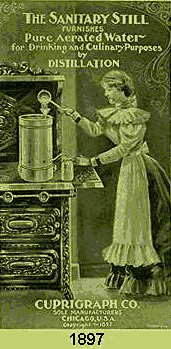 To
remove impurities from water by distillation, the water is usually
boiled in a chamber causing water to vaporize, and the pure (or
mostly pure) steam leaves the non volatile contaminants behind.
The steam moves to a different part of the unit and is cooled until
it condenses back into liquid water. The resulting distillate
drips into a storage container. To
remove impurities from water by distillation, the water is usually
boiled in a chamber causing water to vaporize, and the pure (or
mostly pure) steam leaves the non volatile contaminants behind.
The steam moves to a different part of the unit and is cooled until
it condenses back into liquid water. The resulting distillate
drips into a storage container.
Salts, sediment, metals - anything that won't boil or evaporate - remain in the distiller and must be removed. Volatile organic compounds (VOCs) are a good example of a contaminant that will evaporate and condense with the water vapor. A vapor trap, carbon filter, or other device must be used along with a distiller to ensure a more complete removal of contaminants. The advantages of Distillation include:
The disadvantages of Distillation include:
You might want to check NSF International to see if the distillation system you are interested in purchasing is certified. I have had a number of questions asking if distilled water (or water with most of the ions removed by reverse osmosis or deionization) are either bad for a person's health or beneficial for health relative to purified water that still contains ions (usually calcium and magnesium). Click here to view my response to that question. |
 Water
pressure is used to force water molecules through a membrane that
has extremely tiny pores, leaving the larger contaminants behind.
Purified water is collected from the "clean" side of the membrane,
and water containing the concentrated contaminants is flushed down
the drain from the "contaminated" side. The average RO system
has several components consisting of: Water
pressure is used to force water molecules through a membrane that
has extremely tiny pores, leaving the larger contaminants behind.
Purified water is collected from the "clean" side of the membrane,
and water containing the concentrated contaminants is flushed down
the drain from the "contaminated" side. The average RO system
has several components consisting of:
They cost from about $150 to over $1,500 for point of use systems. The advantages of Reverse Osmosis include:
The disadvantages of Reverse Osmosis include:
You might want to check NSF International to see if the Reverse Osmosis system you are interested in purchasing is certified.
I have received a number of questions asking if distilled water is either bad for a person's health or beneficial for health relative to purified water that still contains ions (usually calcium and magnesium). This question pertains equally well to water from a RO system, because most ions have been removed by the treatment. Click here to view my response to that question. |
| The topic of water filters is complicated because there are so many models available (over 2,500 different models manufactured by more than 500 companies), and because there are so many types of filtration strategies and combinations of strategies used. The basic concept behind nearly all filters, however, is fairly simple. The contaminants are physically prevented from moving through the filter either by screening them out with very small pores and/or, in the case of carbon filters, by trapping them within the filter matrix by attracting them to the surface of carbon particles (the process of adsorption). | |
|
|
Two main types of filters: Sediment and Activated Carbon filters are discussed below, and sometimes they are combined into a single unit. A third type, Reverse Osmosis (RO) is a type of membrane filtration that works differently and will be considered as a separate topic. |
|
|
You will read about micron or sub micron filtration. This is a measure of how good the filter is at removing particles from the water - smaller is better. A micron is a unit of measure - one micron is about 1/100 the diameter of a human hair. A filter that removes particles down to 5 microns will produce fairly clean-looking water, but most of the water parasites, bacteria, cryptosporidia, giardia, viruses, etc. will pass through the pores. A filter must trap particles one micron or smaller to be effective at removing cryptosporidia or giardia cysts. Viruses can not be removed with complete reliability by any filtration method. In theory, reverse osmosis will remove viruses, but a small flaw in the membranes would allow viruses to pass undetected into the 'filtered' water. Click here to view a figure that compares the relative size of several biological contaminants with the pore size of some common filters. |
|
|
A benefit of all home sediment and activated carbon filtration systems (and membrane filters with larger pores) is that they are passive. That is, they do not require electricity to filter the water, and normal home water pressure is used to force the water though the filter - in emergencies, water can even be siphoned through them to provide some treatment. The only routine maintenance required is periodic replacement of the filtration element. As long as the cost of the replacement filter elements is reasonable, owning a even a high-end water filter can be very inexpensive if you look at the long term costs and compare it with other solutions.. |
|
Sediment
Filters - Solid Particles
are Strained Out of the Water: |
|
|
|
Fiber Filters: These filters contain cellulose, rayon or some other material spun into a mesh with small pores. If you take a piece of cloth and pour water containing sand through it you will get the picture. Suspended sediment (or turbidity) is removed as water pressure forces water through tightly wrapped fibers. Some small organic particles that cause disagreeable odors and taste may also be removed. These filters come in a variety of sizes and meshes from fine to coarse, with the lower micron rating being the finer. The finer the filter, the more particles are trapped and the more often the filter must be changed. |
|
|
Fiber filters are often used as pre-filters to reduce the suspended contaminants that could clog carbon or RO filters. |
|
|
Fiber filters will not remove contaminants that are dissolved in the water, like chlorine, lead, mercury, trihalomethanes and other organic or inorganic compounds. |
|
|
Ceramic Filters: Ceramic filters are much like fiber filters and use a process where water is forced through the pores of a ceramic filtration media. This provides mechanical filtration only. This type of filter can reduce asbestos fibers, cysts (if the pores are one micron or smaller), some bacteria (with pore sizes in the 0.2 - 0.8 micron range**) and other particulate matter. |
 |
Ceramic filters will not remove contaminants that are dissolved in the water, like chlorine, lead, mercury, trihalomethanes and other organic or inorganic compounds, nor will they remove viruses. These filters may be used as a back-end to an activated carbon filter to provide a more thorough removal of contaminants. |
** NOTE - NSF does not certify filters for bacterial or viral removal, and I am unaware of any independent certification process for their removal.
Activated
Carbon Filters:Contaminant reduction in AC filters takes place by two processes, physical removal of contaminant particles, blocking any that are too large to pass through the pores (obviously, filters with smaller pores are more effective), and a process called adsorption by which a variety of dissolved contaminants are attracted to and held (adsorbed) on the surface of the carbon particles. The characteristics of the carbon material (particle and pore size, surface area, surface chemistry, density, and hardness) influence the efficiency of adsorption.
 AC
is a highly porous material; therefore, it has an extremely high surface
area for contaminant adsorption. One reference mentions "The equivalent
surface area of 1 pound of AC ranges from 60 to 150 acres". Another
article states, "Under a scanning electron microscope the activated
carbon looks like a porous bath sponge. This high concentration of
pores within a relatively small volume produces a material with a phenomenal
surface area: one teaspoon of activated carbon would exhibit a surface area
equivalent to that of a football field." (estimates
of surface area vary from different sources - RJ)
AC
is a highly porous material; therefore, it has an extremely high surface
area for contaminant adsorption. One reference mentions "The equivalent
surface area of 1 pound of AC ranges from 60 to 150 acres". Another
article states, "Under a scanning electron microscope the activated
carbon looks like a porous bath sponge. This high concentration of
pores within a relatively small volume produces a material with a phenomenal
surface area: one teaspoon of activated carbon would exhibit a surface area
equivalent to that of a football field." (estimates
of surface area vary from different sources - RJ)
 AC
is made of tiny clusters of carbon atoms stacked upon one another.
The carbon source is a variety of materials, such as peanut shells, coconut
husks, or coal. The raw carbon source is slowly heated in the absence
of air to produce a high carbon material. The carbon is activated
by passing oxidizing gases through the material at extremely high temperatures.
The activation process produces the pores that result in such high adsorptive
properties. An article about
Activated Carbon states that "Activated
carbon is one of the best tools which can be used to reduce risks to human
health and provide an aesthetically pleasing product at reasonable cost."
The article also describes how AC works and has some of the best scanning
electron microscope pictures of actual AC granules I have seen.
AC
is made of tiny clusters of carbon atoms stacked upon one another.
The carbon source is a variety of materials, such as peanut shells, coconut
husks, or coal. The raw carbon source is slowly heated in the absence
of air to produce a high carbon material. The carbon is activated
by passing oxidizing gases through the material at extremely high temperatures.
The activation process produces the pores that result in such high adsorptive
properties. An article about
Activated Carbon states that "Activated
carbon is one of the best tools which can be used to reduce risks to human
health and provide an aesthetically pleasing product at reasonable cost."
The article also describes how AC works and has some of the best scanning
electron microscope pictures of actual AC granules I have seen.
The
adsorption process depends on the following factors:
1) physical properties
of the AC, such as pore size distribution and surface area;
2) the chemical
nature of the carbon source, or the amount of oxygen and hydrogen associated
with it;
3) chemical composition and concentration of the contaminant;
4) the temperature and pH of the water; and
5) the flow rate or
time exposure of water to AC.
Interesting articles:
What is Activated Carbon,
Adsorption,
History of AC.
|
|
The effectiveness of carbon filters
to reduce contaminants is affected by the factors
affecting adsorption listed above and three additional characteristics
of the filter, contact time
between the water and the carbon material, the
amount of carbon in the filter,
and pore size.
|
||||||
|
|
Because of the filter characteristics discussed above, the most effective Point of Use activated carbon filters are large SBAC filtration systems, and the least effective are the small, pour-through pitcher filters. | ||||||
|
|
Activated carbon filter cartridges will, over time, become less effective at reducing contaminants as the pores clog with particles (slowing water flow) and the adsorptive surfaces in the pores become filled with contaminants (typically not affecting flow rate). There is often no noticeable indication that a carbon filter is no longer removing contaminants, so it is important to replace the cartridge according to the manufacturer's instructions. The overall water quality (turbidity or presence of other contaminants) also affects the capacity of activated carbon to adsorb a specific contaminant. | ||||||
|
|
It is important to note, particularly when using counter-top and faucet-mount carbon filtration systems, that hot water should NEVER be run through a carbon filter. I have seen warnings about possible damage to the filter from hot water. Perhaps more importantly, hot water will tend to release trapped contaminants into the water flow potentially making the water coming out of the filter more contaminated than the water going in. |
|
|
Granular Activated Carbon (GAC):
In this type of filter, water flows through a bed of loose activated carbon granules which trap some particulate matter and remove some chlorine, organic contaminants, and undesirable tastes and odors. The three main problems associated with GAC filters are: channeling, dumping, and an inherently large pore size. Most of the disadvantages discussed below are not the fault of the activated carbon filtration media, rather, the problem is the design of the filters and the use of loose granules of activated carbon. |
||||||||||||||
The advantages of GAC filters include:
|
|||||||||||||||
The disadvantages of GAC filters include:
|
|
|
Solid Block Activated Carbon
(SBAC): Activated carbon is the primary raw material in solid carbon block filters; but instead of carbon granules comprising the filtration medium, the carbon has been specially treated, compressed, and bonded to form a uniform matrix. The effective pore size can be very small (0.5 - 1 micron). SBAC, like all filter cartridges, eventually become plugged or saturated by contaminants and must be changed according to manufacturer's specifications. Depending on the manufacturer, the filters can be designed to better reduce specific contaminants like arsenic, MTBE, lead etc. |
||||||||||||||||||
The advantages of SBAC filters include:
|
|||||||||||||||||||
The disadvantages of SBAC filters include:
|
|||||||||||||||||||
| To ensure that marketing claims are accurate, check
NSF
International to see if the SBAC filtration system you are interested
in purchasing is certified to significantly reduce the contaminants
you are concerned about.
An example of a certified list of contaminants significantly
reduced by a high-end SBAC filtration system A few SBAC filtration systems have also been certified for arsenic reduction: |
GAC
Pitcher Filters and SBAC Faucet Mount Filters
In addition to legitimate, effective water treatment methods, there are numerous processes that promoters - including friends and family - will try to convince you can alter the physical, chemical properties or energy levels of water molecules. Drinking this "altered" or "enhanced" water is alleged to produce some health benefits.
Select Treatment Method:Boiling:
If the water is cloudy, it should be filtered before boiling. Filters designed for use when camping, coffee filters, towels (paper or cotton), cheesecloth, or a cotton plug in a funnel can be effective ways to filter cloudy water.
Place the water in a clean container and bring it to a full boil and continue boiling for at least 3 minutes (covering the container will help reduce evaporation). If you are more than 5,000 feet above sea level, you must increase the boiling time to at least 5 minutes (plus about a minute for every additional 1,000 feet). Boiled water should be kept covered while cooling.
The advantages of Boiling Water include:|
|
Pathogens that might be lurking in your water will be killed if the water is boiled long enough. |
|
|
Boiling will also drive out some of the Volatile Organic Compounds (VOCs) that might also be in the water. This method works well to make water that is contaminated with living organisms safe to drink, but because of the inconvenience, boiling is not routinely used to treat drinking water except in emergencies. |
The disadvantages of Boiling Water include:
|
|
Boiling should not be used when toxic metals, chemicals (lead, mercury, asbestos, pesticides, solvents, etc.), or nitrates have contaminated the water. |
|
|
Boiling may concentrate any harmful contaminants that do not vaporize as the relatively pure water vapor boils off. |
|
|
Energy is needed to boil the water, so it may be difficult to boil water in an emergency. |
Ultra
Violet Light: |
No known toxic or significant nontoxic byproducts introduced. |
|
Removes some organic contaminants, although specifics are difficult to locate. |
|
Leaves no smell or taste in the treated water. |
|
Requires very little contact time (seconds versus minutes for chemical disinfection). |
|
Improves the taste of water because some organic contaminants and nuisance microorganisms are destroyed. |
|
Many pathogenic microorganisms are killed or rendered inactive. |
|
Does not affect minerals in water. |
|
|
UV radiation is not suitable for water with high levels of suspended solids, turbidity, color, or soluble organic matter. These materials can react with UV radiation, and reduce disinfection performance. Turbidity makes it difficult for radiation to penetrate water and pathogens can be 'shadowed', protecting them from the light. |
|
|
UV light is not effective against any non-living contaminant, lead, asbestos, many organic chemicals, chlorine, etc. |
|
|
Tough cryptosporidia cysts are fairly resistant to UV light. |
|
|
Like Ozone, UV light can degrade some organic compounds into equally harmful byproducts. |
|
|
Requires electricity to operate. In an emergency situation, when the power is out, the purification will not work. |
|
|
UV is typically used as a final purification stage on some filtration systems. If you are concerned about removing contaminants in addition to bacteria and viruses, you would still need to use a quality carbon filter or reverse osmosis system in addition to the UV system. |
Water
Softener | Ion Exchange: Several factors govern the efficiency of a cationic softener:
Type & quality
of resin used;
Amount of salt per
cubic foot of resin for regeneration;
Brine concentration
in the resin bed during regeneration;
Brine flow rate through
the resin bed (contact time) during regeneration;
Raw water hardness;
Raw water temperature
- softeners perform better at higher temperatures; and
Optimal flow rate
of hard water through the resin bed.
Although not as commonly used, potassium chloride can be used to create the salt brine for softeners designed to use KCl. In that case potassium rather than sodium is exchanged with calcium and magnesium. Before selecting an ion exchange water softener, test water for hardness and iron content. When selecting a water softener, the regeneration control system, the hardness removal capacity, and the iron limitations are three important elements to consider. More information on Hard Water and Softening.
The advantages of water softeners include:
|
The nuisance factor of hard water is reduced. |
|
|
Some other other cations like barium, radium and iron may be reduced depending on the manufacturer's specifications. |
|
|
The process of regenerating the ion exchange bed dumps salt water into the environment. |
|
|
The elevated sodium concentration of most softened water can affect the taste and may not be good for people on low sodium diets, although sodium concentrations are typically quite low relative to sodium levels in most food. |
|
|
Cation exchange does not reduce the level of anions (like nitrates), or biological contaminants (bacteria, viruses, cysts) ; nor does the process reduce the levels of most organic compounds. |
|
|
Typically, approximately 50 gallons of rinse water per cubic foot of resin is required to totally remove hardness and excess salt from the resin after each regeneration. |
Water
Deionizers use both Cation and Anion Exchange to exchange both positive
and negative ions with H+ or OH- ions respectively, leading to completely
demineralized water. Deionizers do not remove uncharged compounds
from water, and are often used in the final purification stages of producing
completely pure water for medical, research, and industrial needs.
A potential problem with deionizers is that colonies of microorganisms can become established and proliferate on the nutrient-rich surfaces of the resin. When not regularly sanitized or regenerated, ion-exchange resins can contaminate drinking water with bacteria.
KDF:
|
|
Remove chlorine (actually changes free chlorine to a less active form). |
|
|
Kill algae and fungi. |
|
|
Control bacterial growth in the filter. |
|
|
Remove hydrogen sulfide, iron, lead, cadmium, aluminum, mercury, arsenic and other inorganic compounds. |
|
|
Partially reduce hardness. |
|
|
Remove hydrogen sulfide, iron, lead, cadmium, aluminum, mercury, arsenic and other inorganic compounds. |
Zinc and copper are the preferred metals used in the KDF alloy since both are relatively good reducing agents with respect to common inorganic contaminants (such as chlorine), and both can be tolerated in solution in moderate concentrations without adverse side effects.
The advantages of KDF filters include:
|
|
KDF is the only filter medium I am aware of that claims to remove contaminants from running hot water (unlike carbon filters where hot water can release trapped contaminants into the water stream). This makes them ideal for use in the shower. |
|
|
The filters change the free chlorine some people are allergic to into a form (zinc chloride) that is much more easily tolerated. |
|
|
KDF filters do not, by themselves, remove organic chemicals (pesticides, disinfection byproducts, MTBE, etc.), or parasitic cysts (giardia and cryptosporidium). If you are concerned about removing any of these contaminants, other strategies will be needed in addition to the KDF media. |
|
|
KDF filters need to be backwashed periodically with hot water to remove the insoluble contaminants. This method wastes many gallons of hot water and there is no way to prevent dislodged pollutants from coming out later with the supposedly filtered water. |
Ozone:Ozone is a naturally occurring component of fresh air. It can be produced by the ultraviolet rays of the sun reacting with the Earth's upper atmosphere (which creates a protective ozone layer), by lightning, or it can be created artificially with an ozone generator.
The ozone molecule contains three oxygen atoms whereas the normal oxygen molecule contains only two. Ozone is a very reactive and unstable gas with a short half-life before it reverts back to oxygen. Ozone is the most powerful and rapid acting oxidizer man can produce, and will oxidize all bacteria, mold and yeast spores, organic material and viruses given sufficient exposure.
The advantages of using Ozone include:|
|
Ozone is primarily a disinfectant that effectively kills biological contaminants. |
|
|
Ozone also oxidizes and precipitates iron, sulfur, and manganese so they can be filtered out of solution. |
|
|
Ozone will oxidize and break down many organic chemicals including many that cause odor and taste problems. |
|
|
Ozonation produces no taste or odor in the water. |
|
|
Since ozone is made of oxygen and reverts to pure oxygen, it vanishes without trace once it has been used. In the home, this does not matter much, but when water companies use ozone to disinfect the water there is no residual disinfectant, so chlorine or another disinfectant must be added to minimize microbial growth during storage and distribution. |
|
|
Ozone treatment can create undesirable byproducts that can be harmful to health (e.g., formaldehyde and bromate) if they are not controlled. |
|
|
The process of creating ozone in the home requires electricity. In an emergency with loss of power, this treatment will not work. |
|
|
Ozone is not effective at removing dissolved minerals and salts. |
Caution - The effectiveness of the process is dependent, on good mixing of ozone with the water, and ozone does not dissolve particularly well, so a well designed system that exposes all the water to the ozone is important.
In the home, ozone is often combined with activated carbon filtration to achieve a more complete water treatment.
Activated
Alumina:The advantages of Activated Alumina filters include:
|
|
An effective way to reduce levels of fluoride, arsenic, and selenium without using distillation or reverse osmosis. |
The disadvantages of Activated Alumina filters include:
|
|
The use of other treatment methods would be necessary to reduce levels of other contaminants of health concern |
'Altered' or 'Enhanced' Water:
Note - Oxygenated water, discussed below, is just one example of the hundreds of 'altered' or 'enhanced' water products promoted on the internet and in some health food stores. These products all have several characteristics in common that are discussed in more detail on the Altered Water and Drinking Water Scams pages. It is easier to demonstrate the flaws in Oxygenated water claims than in other products that claim to use some exotic physical or chemical process, but just like oxygenated water, none of the other products are able to withstand critical scientific review.
Regardless of any alleged health benefits, these products are extremely effective at separating customers from their money - I have seen some of this bottled water sell for more than $20 a gallon plus shipping (that's over 3,000 times greater than the cost of tap water)! Many of the 'altered' water products sell for $10 to $15 per gallon. Water 'ionizers' that generate alkaline water produce sodium hydroxide (an effective drain cleaner) and bleach and sell for up to $5,000.
Let's look briefly at one 'altered' water example:
O2Cool oxygenated water
(bottled with 8 times the normal amount of oxygen), formally hiOsilver
oxygenated water:
Why drink O2Cool oxygen water? According to the
marketing hype, it provides "extra energy and vitality, fresh breath,
healthier gums and teeth. We do not know all of the benefits of drinking
O2Cool Oxygen Water. Many people report that they feel energized
after a bottle. Studies have been done showing enhanced sports performance
for athletes drinking oxygenated water. With O2Cool, many people report
that their headaches disappear, even migraine headaches. One bottle of O2Cool Oxygen
Water and you will see why we are proud of the many benefits it offers over
ordinary bottled waters . . . " Although the company claims
that studies have shown enhanced sports performance after drinking Oxygenated
Water, there were no supporting references provided, and the two
studies listed below reported no benefits.
O2Cool oxygenated water
water sells for $44 (for twenty four, 16 oz bottles - 3 gallons) but you
do get free shipping! If my math is correct, that's over $14.50
per gallon. By comparison, tap water costs around $0.007 per gallon
(2,000 times less than the oxygenated water). The highest quality
filtered water is about $0.07 per gallon (that
is still over 200 times less expensive than the oxygenated water).
I suppose some people might be able to justify the exorbitant cost IF the
product performed as advertised --- but does it?
The super oxygenating water cooler system marketing materials
make these 'exciting' claim - and a
skeptical review
- Extra supply of oxygen to the body for overall
health improvement
- Enhancement of the brain function for clearer thinking
and alertness
- More oxygen to the muscle to increase energy and performance
- More oxygen to skin cells for healthier, younger looking skin
- Enhanced metabolism and waste removal
- Enhancement of the body's
ability to fight bacteria and viruses
- Better absorption of vitamins,
minerals and other nutrients
(A 2011
update - the Oxygenating Cooler is apparently no longer on the market)
 |
There is less dissolved oxygen in 1 liter of 'oxygenated water' than in 1 breath of air. Taking an extra breath of air when exercising would be substantially less expensive than paying $1 to $2 for a liter of these products! |
|
|
The primary way to transport oxygen in the body is bound to hemoglobin in the red blood cells. In normal healthy exercisers, hemoglobin leaving the lungs is already 97% to 98% saturated with oxygen. |
|
|
The structure of the circulatory system ensures that any oxygen picked up in the digestive system would go through the lungs before reaching the muscles, brain and other tissues. In the lungs any extra oxygen in the blood will reduce the amount of oxygen transferred to the blood - the final oxygen saturation of the hemoglobin in a healthy person would still be 97% to 98% - no more & no less . |
|
|
Oxygenating water has no effect on the body's ability to absorb the oxygen into the bloodstream or transfer it throughout the body.. |
|
|
The concept of obtaining significant amounts of oxygen through the digestive system makes as much scientific and physiological sense as quenching your thirst by inhaling a glass of water into your lungs. Water that you drink can take up to an hour or more to travel to the intestines where it is absorbed - the water you inhale into your lungs will absorb into your bloodstream almost immediately - so doesn't it make sense to quench your thirst by inhaling a glass of water? Do not try this experiment!! This is not an endorsement for inhaling water. The point is, the respiratory system is designed to absorb oxygen, no water! Oxygenated water makes sense for fish that have specialized structures (gills) for exchanging oxygen and carbon dioxide in an aquatic environment, but not for mammals. Similarly, the digestive system is designed to absorb water and nutrients, not oxygen! |
American Council on Exercise (ACE) Study Investigates Super Oxygenated Water Claims - Results of a study done to test health claims. Conclusion: �At this time, there is no scientific evidence or logical rationale to suggest that drinking super oxygenated water can in any way increase the amount of oxygen in the blood stream,� said Porcari. �Therefore, any potential benefits of super oxygenated water would undoubtedly be attributed to the placebo effect.
A single breath of air contains more oxygen than a bottle of oxygenated water. Despite advertising claims that oxygenated water can boost sports performance, a study in the Nov. 12, 2003, Journal of the American Medical Association found that compared with tap water, it had no effect on 9 exercise-performance measures in 11 healthy men and women. The paper concluded that a single breath contains 100 ml of oxygen, and that's more than can be dissolved in a bottle of oxygenated water. Another article in the Sep, 2006 British Journal of Sports Medicine concluded, "In summary, oxygenated water fails both quantitative analysis and practical physiological tests of exercise performance and recovery."
Ben Goldacre of The Guardian reviews Oxygizer Oxygenated water bottled in Austria.Another reason Oxygenated water was selected as an example is because there are actually some well-conducted experiments available that demonstrate that the product does not perform as advertised. With most of the 'altered' water products, scientists do not bother spending the time or resources to refute claims which they perceive as completely and obviously bogus and not worth examining..
Be aware of the following when evaluating Oxygenated or other 'Magical' products:|
|
None of these products is effectively regulated by the
government (over and above standard rules to ensure safety of bottled
water - discussed under the
Bottled Water
section above). Companies seem completely free to make
any unsubstantiated claims they wish (except specific health
claims - which would place them under the jurisdiction of the FDA
where they would be required to scientifically prove their claims).
If a distributor of one of these products makes claims that a specific
disease (diabetes, arthritis, cancer, heart problems, etc.) can
be cured by drinking the water |
|
|
With that in mind, read the promotions very, very carefully. You will find that the companies describe various health conditions in great detail. Then they attribute the condition (sometimes accurately) to a lack of water, or polluted water, or insufficient oxygen, etc. However, they seldom link their specific process of treating the water directly to solving the specific health problem they discussed - except in the most general, unverifiable way, like 'drinking enough water is critical to your health', or 'drinking our water will reduce stress and give you more energy', or 'our water will detoxify your body and boost metabolism'. |
|
|
Any claims on the site that directly link the specific water treatment to specific health benefits are typically made by 'others' in testimonial statements. There are no regulations in place to ensure that testimonials are either truthful or accurate or even come from real individuals. |
|
|
There will be much mention in the promotional materials about scientific tests proving that a particular water treatment has some benefit to the body, to endurance, to mental function, or whatever. There will be, however, a complete lack of substantiated scientific evidence to back up those claims. Acceptable evidence would be experimental results published in reputable journals that have been reviewed by other scientists to make certain the experiments were designed, carried out (and interpreted) correctly and with minimal bias. |
Aqua Scams - The purpose of this site is to examine the scientific validity of the explanations given by the proponents of "alternative" water treatment devices or, in the case of "clustered water", of a fictional alternative form of water that is purported to be a restorer of youth and vigor. My motivation for doing this is entirely non-vested and very simple: after thirty-four years of teaching general, physical, and environmental Chemistry, it disturbs me to see my favorite science presented incorrectly (and often mangled into pseudoscience) in the promotion of processes or devices offered to the public (Stephen K. Lower, Ph. D., site author). Other relevant topics Dr. Lower discusses: Cluster Quackery, Structure-altered water nostrums and nonsense and Oxygenated water, pseudoscientific snake-oil.
Penta Water has fascinated me since its release in 1999. After I began researching water-related subjects, it was the first product that I remember being exposed to for which extraordinary claims were made - I saw it at a health food store and picked up the literature. Originally the product was marketed with remarkable claims of how water had been treated with special processes to form stable clusters of five water molecules that could be absorbed better and contribute to a host of health benefits. I even had a promotional cassette tape in which the inventor described Penta Water's miraculous properties - unfortunately I lost track of it over the years.
Penta Water has made a number of claims over the years - and changed
them regularly as
documented
here and
here, although, as noted, most of the wilder claims have been removed
from the official website. A number of
alleged studies have also been cited over the years, and again eventually
removed from the company website. Ben Goldacre of the Guardian has
commented several times on Penta Water pseudoscience -
here,
here,
here and
here. A site from the James Randi Educational Foundation had several
interesting comments on Penta Water and the foundation's attempts to persuade
the company to participate in their million dollar challenge. Unfortunately
the archive where this fascinating discussion was housed has been discontinued
-
this link provides some background information. I just discovered
WayBack archives in which the original exchange can be seen.
This link is to the WayBack Archive - part 1
This link is to the WayBack Archive - part 2
Index of Water-Related Frauds and Quackery
Water Woo
from Rational Wiki
My response to questions asked by one of my visitors about claims made by companies selling "altered water" and how to evaluate them.
|
|
In the final analysis, I would have to say that I have seen absolutely nothing that would lead me to believe that any of these specialized water treatment methods can do anything at all to increase the health benefits of water that is free of harmful contaminants. |
|
|
I would be extremely interested to see some results of good scientific experiments that demonstrated any beneficial health effects of drinking "altered" water. My belief is that good scientific studies on this topic simply do not exist, because the claims can not be verified. You might ask why don't scientists carry out experiments and publish results refuting these claims if they are not true. My best guess is that for the scientific community these are non-issues. There are far more interesting and important topics to spend valuable research resources and effort on than debunking strange theories and marketing tactics that result in people eagerly spending their money on outrageously priced water products. |
|
|
I often receive questions about Masaru Emoto's books and theories that water is able to receive human thoughts, words, and emotions and change the way it crystallizes - forming beautiful crystals in response to positive thoughts, words, and emotions and ugly crystals (or no crystals) in response to negative thoughts, words, and emotions (or pollution). There is absolutely no scientific evidence to support his claims. I discuss my thoughts on his popularity (among non-scientists) here. |
Top
Chlorination is a water treatment
method that destroys disease-causing bacteria, nuisance bacteria, parasites
and other organisms. Chlorination also removes soluble iron, manganese and
hydrogen sulfide from water. As mentioned, chlorination is not usually
a point of use treatment method except in emergency situations. Instead,
it is used to treat all the water entering a home.
Chlorine can be used to disinfect a well - shock treatment:
University of Missouri Extension
Ohio
State University Extension
or as an continuously applied disinfectant:
University of Nebraska - Lincoln Extension
Maine Center for Disease Control and Prevention
The advantages
of Chlorination include:
|
|
Controls Disease-Causing Bacteria: Disease-causing bacteria may enter your well during construction, repair, flooding or as a result of improper construction. Proper chlorination will kill these bacteria. If disease-causing bacteria enter your water supply on a continuous basis, you must eliminate the source or construct a new water supply. |
|
|
Controls Nuisance Organisms: Chlorine treatment will control nuisance organisms such as iron, slime and sulfate-reducing bacteria. Iron bacteria feed on the iron in the water. Chlorination will kill or control these bacteria. Nuisance bacteria do not cause disease. |
|
|
Mineral Removal: You can remove large amounts of iron from water by adding chlorine to oxidize the clear soluble iron into the filterable reddish insoluble form. Chlorine helps remove manganese and hydrogen sulfide in the same way. |
|
|
Causes Smell and Bad Taste: Chlorine in water (at the levels typically used in water treatment) to is not poisonous to humans or animals. However, if the concentration is great enough the water will taste bad so consumption may be reduced. Some people object to the smell and/or taste of very small amounts of chlorine, and some people may have a sensitivity to chlorine in their water. In those cases an activated carbon or charcoal filter may be used to reduce the chlorine levels in their water. |
|
|
Trihalomethanes (THMs) are organic chemicals that may form when chlorine is used to treat water supplies that contain humic compounds. Humic compounds form as a part of the decomposition of organic materials such as leaves, grass, wood or animal wastes. Because THMs are very seldom associated with groundwater, they are primarily a concern where surface water supplies are used. Lifetime consumption of water supplies with THMs at a level greater than 0.10 milligrams per liter is considered by the Environmental Protection Agency to be a potential cause of cancer. THMs can be removed from drinking water through use of an activated carbon filter. |
|
|
No Nitrate Removal: Chlorine will not remove nitrates from water. The claims of some water treatment firms imply that nitrates can be removed by chlorination. This is not true. Adding chlorine may prevent nitrates from being reduced to the toxic nitrite form; however, nitrates are not removed from water by chlorination. This is relevant only for those who are considering treating their well, spring, or surface water. |
| Treating water with household bleach containing 5.25-8.25 percent chlorine | |
| Volume of Water to be Treated | Bleach Solution to Add |
| 1 quart/1 liter | 5 drops |
| 1/2 gallon/2 quarts/2 liters | 10 drops |
| 1 gallon | 1/4 teaspoon |
| 5 gallons | 1 teaspoon |
| 10 gallons | 2 teaspoons |
Emergency
Chlorination - CHLORINE BLEACH: Common household bleach contains
a chlorine compound that will disinfect water. The procedure to be
followed is usually written on the label. When the necessary procedure
is not given, find the percentage of available chlorine on the label and
use the information in the following tabulation as a guide.Emergency
Water Treatment
|
 Did the water
in the bottle you just purchased really come from the beautiful spring shown
on the label? How can you be sure the water in the bottle is any cleaner
or safer than your tap water? How does the cost, both short term and
long term, compare with other water purification options?
Did the water
in the bottle you just purchased really come from the beautiful spring shown
on the label? How can you be sure the water in the bottle is any cleaner
or safer than your tap water? How does the cost, both short term and
long term, compare with other water purification options?
Bottled water is simply water from some source that a company has placed in a bottle for resale. Bottled water can have minimal (or no) processing - as in natural spring or mineral water, or it can be completely filtered and demineralized to nearly pure water and then have minerals added back to improve the taste.
|
|
But, how can you be sure the water in the bottle you purchased is any cleaner or safer than your tap water? Just like any of the other water treatment solutions, you will find reputable companies that provide a safe, quality product, and you will find companies that fill their bottles using the local, municipal water with marginal treatment. There are 2 regulatory organizations, 1 trade association, and 1 independent certification organization, which contribute to ensuring the safety and quality of bottled water. (An NRDC Discussion of Bottled Water) |
Bottled Water:
Issues and Alternatives

According to the University of Illinois at Urbana-Champaign, College of Agriculture, Cooperative Extension Service, bottled water is regulated at the federal level, and in some cases, at the state level. Bottled water suppliers who are members of the International Bottled Water Association (IBWA) regulate themselves and are given unannounced inspections by NSF International. Bottled water companies can also have their product certified by NSF International.
Federal standards - Bottled water is regulated by the Food and Drug Administration (FDA), which requires manufacturers to submit samples regularly for testing. In the United States, the concentration of contaminants found in bottled water must be less than the "allowable levels" set by the FDA which are essentially the same as the maximum contaminant levels that the EPA requires municipal water supplies to meet.
State standards - Individual states must enforce the federal bottled water regulations, but they can also pass stricter standards.
International
Bottled Water Association. The bottled water industry regulates
itself through the International Bottled Water Association (IBWA).
Bottled
water FAQs. The IBWA sets manufacturing requirements, which help
to ensure that bottlers meet FDA health standards. Bottled water producers
who are members of IBWA are inspected annually by an independent laboratory,
the National Sanitation Foundation. Through unannounced inspections,
members are evaluated on compliance with the IBWA's performance requirements
and FDA Quality Standards.
Not all bottled water manufacturers are members
of the IBWA. Of the 475 bottling plants in the United States (in 1994),
250 are members. The label may indicate whether a bottled water comes
from a member company.
You might want to check NSF International to see if the bottled water you are interested in purchasing is certified. The NSF Bottled Water Certification Program is an annual, voluntary certification process that includes both extensive product evaluations as well as on-site audits of bottling facilities. The NSF testing program provides for annual unannounced plant inspections covering every aspect of a bottler's operation, from the source of the water, through the disinfection and treatment process, and including the container closure process. The company also performs extensive product testing for over 160 chemical, inorganic, radiological, and microbiological contaminants. An interesting article from Scientific American magazine on bottled water.
Advantages of Bottled Water include:|
|
An emergency source of water in the event your primary water source fails or becomes contaminated. |
|
|
A convenient source of usually safe water for drinking outside of the home. |
|
|
Bottled water, since it does not contain chlorine, and may contain a mix of minerals to enhance flavor, may taste better than untreated tap water. |
|
|
Most bottled water will contain fewer contaminants than untreated tap water. |
The bottled water industry would like the public to believe that bottled water is more pure and safer than tap water and water produced by other treatment methods. The actual quality of bottled water depends on the bottling company, and most is usually good. High quality home water treatment methods (filtration, reverse osmosis, and distillation) can usually produce water of equal or better quality more economically, however.
The disadvantages of Bottled Water include:|
|
Cost
|
||||||||
|
|
Inconvenience - Using bulk bottled water requires moving and storing jugs or bottles of water. Water weighs about eight pounds per gallon, or about 40 pounds per five gallon bottle. Failure of a small valve can lead to a big mess, as I discovered after arriving home one evening after a long day at work to find 3 gallons of water soaking into the kitchen rug. | ||||||||
|
|
Negative Environmental Impact - Producing bottles uses resources, and unless they are reused or recycled, they cause a waste disposal problem. Recycle or reuse the empty bottles, if at all possible. Transporting bottles of water from the bottler to stores or homes also uses resources. | ||||||||
|
|
Keep Your Bottle Clean - According to the
University of Illinois at Urbana-Champaign, College of Agriculture,
Cooperative Extension Service, "If
you choose bottled water after careful investigation, keep in mind
that all of your hard work will go to waste if you aren't careful
about keeping your bottled water clean. You have to be faithful
in maintaining the hygiene of your bottled water, or you may increase
your exposure to bacteria. Bacteria grow best in warm, moist
areas. The wet, warm, threaded cap of an unrefrigerated bottle
of water is a perfect place for bacteria to grow; they will
begin to grow as soon as you break the seal. If ingested,
these bacteria can cause gastrointestinal problems and other health
risks. The key is to maintain the cleanliness of your bottles
and store them properly. Follow these hints:"
|
||||||||
|
|
5 gallon water dispensers must also be kept meticulously clean to prevent bacteria from growing in the reservoir area and bubbling into the bottle. Safety & Health Services cleaning recommendations. (pdf file) |
| Comparison of Drinking Water Treatment Methods | Identify Water Contaminants by Their Sensory Clues |
| Relative Size of Pathogens and Filter Pores | Comparison of Long-Term Costs for Water Treatment |
Comparison
of Drinking Water Treatment Methods|
|
I developed a Comparison Table listing different drinking water treatment technologies and the contaminants they remove to make it easier for you to determine which process, or combination of processes will be best for your particular drinking water situation. The Water Quality Association (WQA) also has a Table of Water Contaminants, their health effects, and removal methods Comparison tables that display treatment methods and contaminants in a different format than the table above are also available. One table covers biological and organic contaminants, and the other table covers inorganic contaminants. |
Identify
Common Water Contaminants by Their Sensory Clues
|
Water Problem Table |

|
Deposits, Spots, &
Sediment Soap scum Bathtub rings Scaly, whitish deposit Spots on clothing Spots on dishes Spotting, mottling, of teeth Red - brown slime Black - brown slime Reddish - brown sediment Grittiness, abrasiveness |
Staining Blue-green stains Brown-red stains Black stains Blackening and pitting Gray stains Yellow stains Taste Alkaline Metallic Salty, brackish Sharp chemical Alkaline Metallic Salty, brackish Sharp chemical |
Color Blue to Blue-green Cloudy, or Milky Reddish - orange Dark brown to Black Yellow
Odor |
Relative
Size of Pathogens and Filter Pores |
|
The pore size of a filter determines how well it removes harmful particulate contaminants like asbestos, parasitic cysts, and bacteria. |
|
|
Solid Block, Activated Carbon filters have very small carbon particles bonded into a tightly packed matrix with uniform pores, typically between 0.5 and 1.0 micron, and can reliably remove small particulate contaminants. |
|
|
Granular Activated Charcoal (GAC) filters have relatively large,
and irregular sized pores (10 microns would probably be the minimum
size to expect), so it is impossible to state with any certainty
what size particles would be removed. Channeling can also
dump unfiltered water into the output stream. GAC only filters should never be relied on exclusively to provide protection from small particulate contaminants. |
 |
Relative Size
Click here to view a full sized figure that compares the relative size of several biological contaminants with the pore size of some common filters. |
Comparison
of Long-Term Costs for Water Treatment
|
||||||||||||||
| * Please be advised that the information on this page and on this site is for general educational information only and is NOT intended to make any specific health claims or recommend any specific treatment method or preventative advice for any health issue or problem. Consult your physician or a health specialist for specific steps to take for your specific health or nutrition requirements! | ||
|
Copyright � 2005, Randy Johnson. All rights reserved. |
Updated April 2015 |
|


